
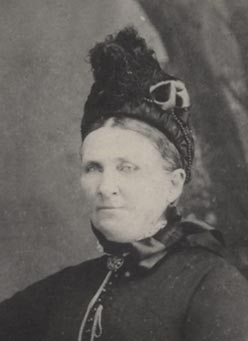
In 2017, an event was held at King’s Cottage in Bunbury to commemorate Bridget Mulqueen, a girl from County Limerick who arrived on the Bride Ship Travancore in 1853 and settled in the Bunbury area, later marrying ex-convict James John Henry Hislop, and becoming – with her husband – an important contributor to the development of the region.
As part of the commemorations, a replica Travel Box – made in Dublin’s Arbour Hill prison – was presented to the museum, symbolising Bridget’s journey from Famine-era Ireland to the emerging Swan River Colony.
Tracing her story from the beginning, we can note that Bridget Mulqueen was born around 1834 in Askeaton, Co Limerick (Lorna Cross – who is Bridget’s great granddaughter – documents her baptism there on 20 June) to John and Catherine nee Sommers. Very little is known about Bridget’s early life, although her parents appear to have had at least five other children, and the family lived in Aghalacka, part of the wider Askeaton parish.
Bridget’s journey to Western Australia began with a journey from either Cork or Dublin to Plymouth – the Travancore’s port of departure. There, she encountered the first official aspect of the emigration process, at the British Government’s Emigration Depot, where her application for assisted passage was assessed, her identity confirmed, and her travel kit checked. The latter would have included a minimum set of clothing consisting of six shifts, two flannel petticoats, six pairs of stockings, two pairs of shoes and two gowns, along with sheets, towels and soap. (The Travel Box replicas were developed to reflect this aspect of the girls’ journey.) Those travelling under assisted passage were also required to pay a £2 deposit to cover their bedding and mess utensils used on board. Together, these processes enabled the Colonial Land and Emigration Commission (CLEC) to ensure that people arriving in the colonies met the required standards in terms of health and character.
The Travancore sailed from Plymouth on 1 October 1852, with a large cohort of Irish girls among the 221 passengers. Norm Flynn and Lorna Cross – in their book about this journey – described four different groups: 30 girls from Nenagh (Tipperary), 30 from Limerick, 26 from Kerry, and seven whose origins were undefined. Bridget was included in the passenger list under the name ‘Biddy Mulqueen’, aged 19 years.
Immigration Agent F. D Wittenoom reported on the journey, stating that it lasted 105 days, with a few complaints about food, as well as five deaths and four births on board. Upon arrival in Fremantle in January 1853, the single girls on assisted passage were transported by boat to the William Street jetty, where they were greeted by locals looking to engage them as servants.
We cannot track exactly when Bridget arrived in Bunbury, although a group of 16 women travelled on the boat Typo to that town under the charge of Enrolled Pensioner Guard, Sergeant Allen, and lodged with Mrs Allen upon arrival in Bunbury.
However, Bridget’s marriage to ex-convict (ticket-of-leave man) James John Henry Hislop is documented in the State Records later that year. In fact, the couple had two wedding ceremonies: a civil one held on 6 October 1853, followed by a Catholic ceremony on 23 October. Both were held in the district of Picton, where the couple lived for much of their married lives, and fellow Travancore girl Catherine McNamara was a witness (along with William White).
Bridget’s new husband had his own fascinating journey to the colony. Originally from Roxburghshire in Scotland, he found himself in the British Army, and in January 1849, he was sentenced (in Dover) to 7 years transportation for stealing a fixture. Arriving on convict ship the Pyrenees in June 1851, Hislop was later appointed schoolmaster in Bunbury, a position which he held from 1853 to 1861. Here, he taught many of the colony’s prominent people, including John and Alexander Forrest. (Both boys grew up to become explorers, with Sir John Forrest becoming the first Premier of Western Australia, while his brother Alexander rose to the position of Perth Lord Mayor.)
When his teaching career ended, Hislop became an accountant, and after that, was proprietor of Bunbury’s Wellington Hotel (which is still standing!) and manager of a boarding house in Wellington Street. In the latter two endeavours, Bridget herself was an important contributor, and together with her husband, became a fixture of Bunbury’s business community.
In addition to this, they had ten children to raise: five sons and five daughters, with the family dividing their time between Picton, Bunbury town, and Quindalup.
Bridget died on 3 April 1907 in the Wellington District.
An article in the Evening Mail carried her obituary:
BUNBURY, This Day.-The remains of the late Mrs. Hislop, senr., were buried late yesterday afternoon. Mrs. Hislop died just before 12 o’clock” on Wednesday night in a painfully sudden manner. She was 73 years of age, and was in apparently good health during the earlier part of the evening, nand about 8 o’clock appeared in good spirits. A paralytic stroke, however, prostrated her, and the services of Br. Joel were obtained twice during tlie night, but all to no avail. Mrs. Hislop was a native of Ireland, and came out here 57 years ago —when she was 16 years of age. She married here, and leaves a husband and family of ten—live sons and five daughters—to mourn her demise. She practically lived her colonial lifetime in Bunbury, and she was well known and respected throughout the district. Mr. Hislop senr., is now over 80 years of age.
James John Henry Hislop died two years later, on 23 October 1909. Both are buried in Bunbury cemetery.